Model
Dynamics
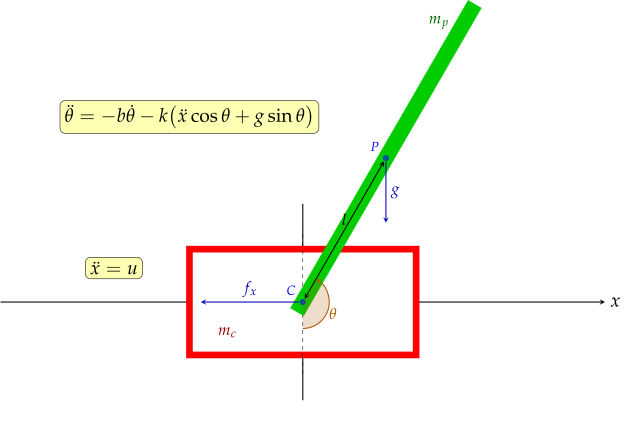
A cart with mass \(m_c\) moves along the \(x\)-axis, so its center \(C\) has coordinates \((x, 0)^T\).
A pole with mass \(m_p\) is attached to the cart with a hinge at point \(C\),
and rotates around with viscous friction.
The pole's center of mass is at \(P\), moment of inertia is \(I_p\).
The angle of rotation is denoted as \(\theta\), measured counterclockwise from the axis \(-y\).
A force \(f_x\) is applied to the cart and the force of gravity \(g\) acts on the pole.
{width="75%"}
\[
\begin{align}
& C = \begin{pmatrix}
x \\ 0
\end{pmatrix}
&& \dot{C} = \begin{pmatrix}
\dot{x} \\ 0
\end{pmatrix} \\
& P = \begin{pmatrix}
x + l \sin \theta \\ - l \cos \theta
\end{pmatrix}
&& \dot{P} = \begin{pmatrix}
\dot{x} + l \dot{\theta} \cos \theta \\ l \dot{\theta} \sin \theta
\end{pmatrix}
\end{align}
\]
The kinetic energy of the cart is
\[
\begin{align}
T_c = \frac{1}{2} m_c \begin{Vmatrix}
\dot{C}
\end{Vmatrix}_2^2 = \frac{1}{2} m_c \dot{x}^2.
\end{align}
\]
As a result energy of the whole system is following
\[
\begin{align}
T & = T_c + T_p = \frac{1}{2} \dot{x}^2 (m_c + m_p) + m_p \dot{x} l \dot{\theta} \cos \theta
+ \frac{1}{2} \dot{\theta}^2 \left( m_p l^2 + I_p \right); \\
U & = \underbrace{U_c}_{0} + U_p = -m_p gl \cos \theta.
\end{align}
\]
To find the dynamics of system, let's use the Euler-Lagrange differential equation, where \(L = T - U\), \(q = (x, \theta)^T\) and \(Q\) is the generalized force.
In our case, we have deal with two forces: motor force \(f_x\) and viscous friction \(f_{\theta}(\theta, \dot{\theta}) = -\mu \dot{\theta}\).
\[
\begin{align}
Q &= \frac{d}{dt} \frac{dL}{d\dot{q}} - \frac{dL}{dq} = \begin{pmatrix} f_x \\ f_{\theta} \end{pmatrix}
\end{align}
\]
Motion equations
\[
\begin{align}
m_p \ddot{x} l \cos \theta + \ddot{\theta} \left(m_p l^2 + I_p\right) + m_p g l \sin \theta &= f_{\theta}(\theta, \dot{\theta}) \\
\ddot{x}(m_c + m_p) + m_p l \ddot{\theta} \cos \theta - m_p l \dot{\theta}^2 \sin \theta &= f_{x}.
\end{align}
\]
Derivation
\[
\begin{equation}
L = \frac{1}{2} \dot{x}^2 (m_c + m_p) + m_p \dot{x} l \dot{\theta} \cos \theta +
\frac{1}{2} \dot{\theta}^2 \left( m_p l^2 + I_p \right) + m_p gl \cos \theta.
\end{equation}
\]
\[
\begin{align}
\frac{dL}{d\theta} & = - m_p \dot{x} l \dot{\theta} \sin \theta - m_p gl \sin \theta \\
\frac{dL}{d\dot{\theta}} & = m_p \dot{x} l \cos \theta + \left(m_p l^2 + I_p\right) \dot{\theta} \\
\frac{d}{dt} \frac{dL}{d\dot{\theta}} & =
m_p \ddot{x} l \cos \theta - m_p \dot{x} l \dot{\theta} \sin \theta + \left(m_p l^2 + I_p\right) \ddot{\theta} \\
\frac{d}{dt} \frac{dL}{d\dot{\theta}} - \frac{dL}{d\theta} & =
m_p \ddot{x} l \cos \theta + \left(m_p l^2 + I_p\right) \ddot{\theta} + m_p g l \sin \theta \\
\end{align}
\]
\[
\begin{align}
\frac{dL}{dx} & = 0 \\
\frac{dL}{d\dot{x}} & = (m_c + m_p) \dot{x} + m_p l \dot{\theta} \cos \theta \\
\frac{d}{dt} \frac{dL}{d\dot{x}} & =
(m_c + m_p) \ddot{x} + m_p l \ddot{\theta} \cos \theta - m_p l \dot{\theta}^2 \sin \theta \\
\frac{d}{dt} \frac{dL}{d\dot{x}} - \frac{dL}{dx} & =
(m_c + m_p) \ddot{x} + m_p l \ddot{\theta} \cos \theta - m_p l \dot{\theta}^2 \sin \theta. \\
\end{align}
\]
Acceleration control
Let's make the assumption that the motor can generate any force necessary for the cart to reach acceleration in \([-a, a]\) on a fixed cart velocity range.
This fact allows us to consider the cart acceleration as a control input and significantly simplify the equations of motion
\[
\begin{align}
\left(m_p l^2 + I_p\right) \ddot{\theta} &= f_{\theta}(\theta, \dot{\theta})
- m_p \ddot{x} l \cos \theta - m_p g l \sin \theta \\
\ddot{x} &= u, \quad u \in [-a, a].
\end{align}
\]
But for practice it's more convenient to use another form
\[
\begin{align*}
\left(m_p l^2 + I_p\right) \ddot{\theta} &= -\mu\dot{\theta} - m_p \ddot{x} l \cos \theta - m_p g l \sin \theta \\
\ddot{\theta} &= -\frac{\mu}{\left(m_p l^2 + I_p\right)}\dot{\theta}
- \frac{\ddot{x} \cos \theta - g \sin \theta}{l + \frac{I_p}{m_p l}}. \\
\end{align*}
\]
Since all parameters do not change over time, we can greatly simplify the motion equations.
Motion equations
\[
\begin{align}
\ddot{\theta} &= -b\dot{\theta} - k \big(\ddot{x} \cos \theta - g \sin \theta\big) \\
\ddot{x} &= u, \quad u \in [-a, a].
\end{align}
\]